MILES TO MEDICINE
Rural Communities Face Alarming Healthcare Gap
By Colin P. McGuire
Senior Editor/Writer
Debbie* thought she was having a heart attack.
It was the end of August, and as a retired medical professional, she knows a thing or two about health crises. Debbie lives in rural Crawford County in a retirement village staffed with a competent crew of nurses ready to provide care.
Still, confronted with this emergency, her daughter, Cindy*, couldn’t calm the “What ifs?”
What if her mother’s condition worsened and snowballed into something that required more immediate and specific care? Would she be in a position to receive that attention before it was too late?
Cindy isn’t alone. As hospitals close and specialists and other healthcare professionals become scarce across Pennsylvania’s rural regions, thousands of residents — many of them aging — share the same concerns. Often, they face long drives for routine and urgent care, and when they arrive, the facilities are overcrowded and the wait is long.
“I’m always concerned with where we live and what’s immediately available,” Cindy says the afternoon after her mother’s visit to the emergency room in nearby Meadville. “She’s stable now and even though she was nervous she was having a heart attack, that was not the case.
“Seeking treatment at a small, independent hospital … they just don’t have the resources available that a larger health system, like Allegheny Health Network, Cleveland Clinic or University of Pittsburgh Medical Center, does. They do the best they can with the resources they have, but I think the entire healthcare system right now is overwhelmed.
“It’s been a wild 48 hours.”
Will it get better?
This wasn’t the first time the mother-daughter duo experienced the pitfalls of requiring urgent care in their area, a region served by Northwestern Rural Electric Cooperative (REC). A few years ago, Cindy took Debbie to the hospital when she had problems after surgery. They checked in around 7 that night, and Debbie wasn’t treated until after 2 the next morning.
Cindy understands the reasons for the backlog: A friend who works in the emergency room told her that since the COVID-19 pandemic brought the country to its knees six years ago, healthcare providers feel like they have been working nonstop. With people leaving the industry with regularity and an aging population throughout Crawford, Erie and Warren counties, she knows there’s a mountain of factors contributing to the scarcity of services.
And yet, she continues to wonder when, how or if it will ever get better.
“Mine isn’t just one personal experience,” Cindy explains. “You can talk to anyone, and they’ll tell you they’ve had challenging circumstances, too. This is a topic of conversation in a lot of places. I’ve talked to people who live in these smaller population pockets and they all kind of tell the same story.
“There’s a primary feeling,” she adds, “and that feeling is frustration.”
The Center for Rural Pennsylvania, an advocate for Pennsylvania’s nearly 3.4 million rural residents, has studied rural healthcare issues extensively. In one recent report, done in partnership with Penn State University, researchers confirmed what patients like Cindy, her mother and others have been experiencing: that rural hospitals continue to face significant workforce, service and access challenges.
“This research provides the General Assembly with important Pennsylvania-specific evidence about the challenges these hospitals face,” Sen. Gene Yaw (R-Lycoming), chairman of the center’s board, says. “As we consider the future of rural healthcare, maintaining access to essential services for rural residents must remain at the center of the conversation.”
That need is becoming more urgent as hospitals continue to close across Pennsylvania.
The Pennsylvania Municipal League reports that more than two dozen hospitals have shut down since 2016, a trend that’s expected to accelerate. In another study, the Hospital and Healthsystem Association of Pennsylvania (HAP) warns that a dozen or more facilities could close in the coming years without state intervention.
Lawmakers are taking action. Recently, state Sen. Lisa Baker (R-Luzerne), who represents constituents in cooperative territories, introduced legislation that would let eligible facilities convert to Rural Emergency Hospital status. The designation would preserve emergency and outpatient care while providing financially vulnerable hospitals with an alternative to closing.
While the legislation is a step in the right direction, rural hospitals will need more solutions like it to overcome the challenges they face.
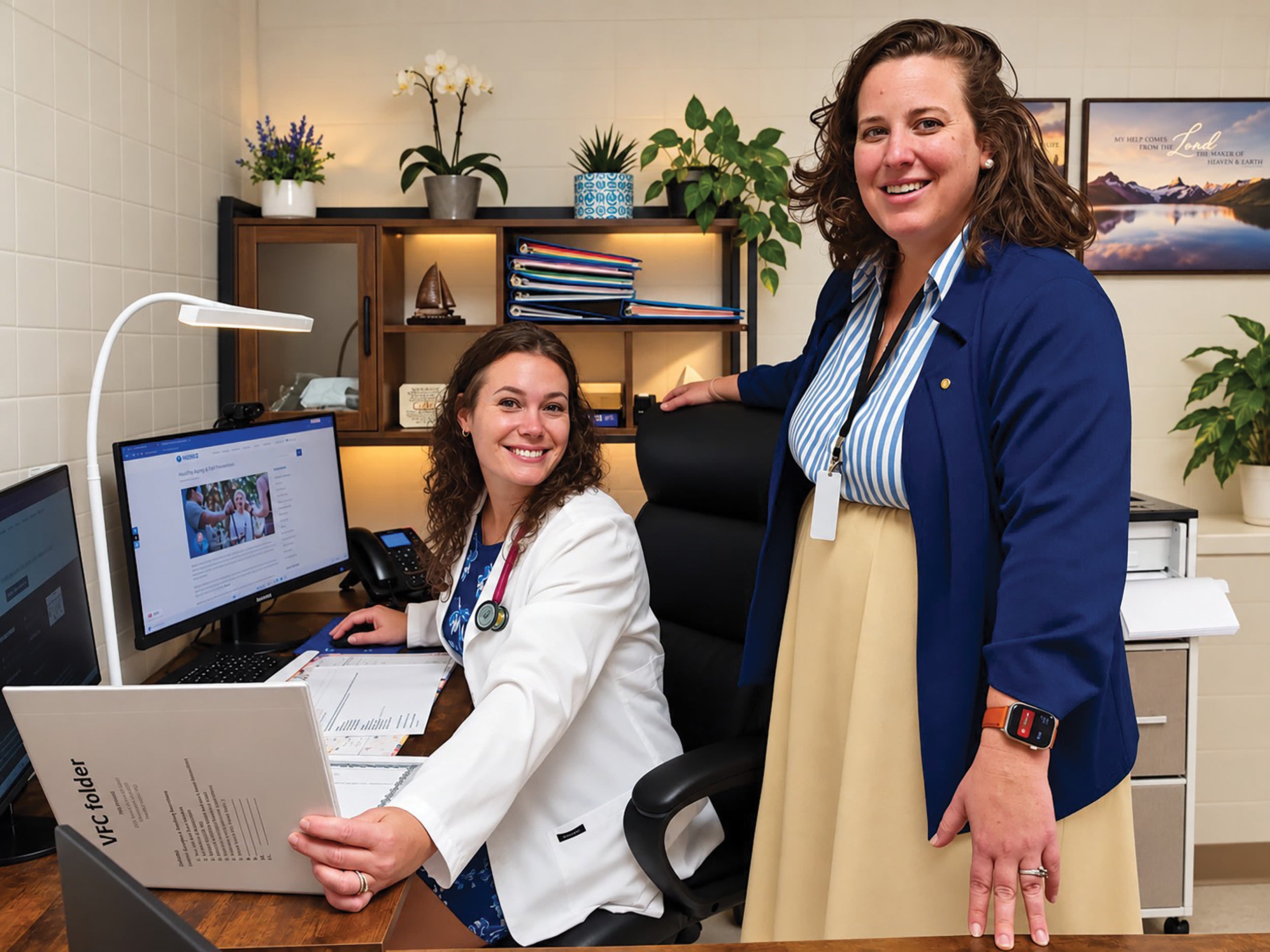
EXPANDING CARD: Maggie Jarmolowicz, left, and Alivia Haibach are part of the leadership team at the Multi-Cultural Health Evaluation Delivery System (MHEDS) in Erie County. The organization, which provides healthcare for people regardless of their ability to pay, is on track to receive a grant that will allow them to operate a mobile unit in Crawford, Erie and Warren counties. With rural Pennsylvania facing a widening healthcare gap, the idea is to bring services to the people, not the other way around. Photo courtesy of MHEDS
Paying the price
Penn Highlands Healthcare, which has facilities in Clearfield, Huntingdon and Jefferson counties — all served by rural electric cooperatives — reported recently that more than a third of the Commonwealth’s hospitals are operating on impossibly thin financial margins, the result of recent cuts in Medicare and Medicaid reimbursements. Traditionally, providers have used this funding to offset their overhead for such things as staff, equipment and facilities.
But, according to HAP, Medicare and Medicaid have been underfunding Pennsylvania hospitals by $3.6 billion annually, and Medicaid reimbursement rates in the Commonwealth are 11 percentage points lower than the national average. As a result, most hospitals are being paid below the cost of the care they deliver.
In 2025, federal Medicaid changes also reduced eligibility for people across the country. In Pennsylvania, the Department of Human Services (DHS) estimates that more than 310,000 Pennsylvanians will lose access to these benefits, Press Secretary Brandon Cwalina says.
“Because hospitals are legally required to provide care regardless of a patient’s ability to pay,” he says, “stripping Medicaid coverage from Pennsylvanians will cause rates of uncompensated care to skyrocket, threaten the closure of at least 25 rural hospitals that rely heavily on Medicaid revenue, and further strain Pennsylvania’s already overwhelmed health system.”
To combat the problem, the state has secured $193 million in federal funding to support its Rural Health Transformation Plan. The five-year effort is focused on improving access to essential health services in communities most impacted by federal Medicaid spending cuts.
Oh, baby
Meanwhile, some rural hospitals, like Warren General in Warren County, are being forced to eliminate services. In January, citing a sudden change in physician availability and difficulty in recruiting doctors, the hospital shut down its labor and delivery services.
Now, expectant mothers in the county, which is served primarily by Warren Electric Cooperative, have two choices when delivering: travel to UPMC Hamot in Erie, which is about 70 miles from Warren General, or head out of state to UPMC Chautauqua in New York, which is about 20 miles away.
Warren County is part of what the Center for Rural Pennsylvania has dubbed a “maternity care desert,” which encompasses seven other bordering counties — Cameron, Clarion, Clinton, Elk, Forest, McKean, and Potter — and is home to an estimated 35,000 women of childbearing age. The issue, however, goes much deeper. According to the center, 23 of Pennsylvania’s 67 counties do not have a hospital that provides labor and delivery services.
“It’s a major issue in rural Pennsylvania,” Cwalina says. “In counties like Elk, Potter and Warren, OBGYN shortages have left nearly half of rural women more than 30 minutes from the nearest birthing hospital.
“All Pennsylvanians deserve access to quality healthcare — no matter where they live.”

If you ask Patti Jackson-Gehris how to fix Pennsylvania’s rural healthcare problems, she’ll give you four ideas almost immediately.
She would know. As the regional president for UPMC North Central Pa., she oversees facilities in Muncy, Williamsport and Wellsboro, regions served by Sullivan County REC and Tri-County REC. Having more than 30 years of experience of healthcare leadership under her belt, she boiled the most pressing points down to food insecurity, workforce, funding and technology.
“Food is health and wellness,” she says. “If people don’t have access to a stable, healthy amount of food, it causes so many issues and diseases. We also continue to need exceptional nurses, but it’s really hard to attract that type of talent to these types of communities.
“Then there’s legislation out there that causes significant concerns with reimbursements and costs,” she continues. “One in five people with Medicaid will lose that coverage in Pennsylvania. Uncompensated care in hospitals is rising, and if we have fewer Medicaid people to take care of, state funding is at risk. Plus, we want to leverage technology and look at innovative ways it can reduce the cost of delivering care to people in rural areas.”
While Jackson-Gehris is optimistic about the healthcare system’s ability to take care of rural communities, she was adamant about the need for facilities to be proactive and embrace change.
“Staying the same is not an option,” she says. “We’re going to have to look different three, five, 10 years from now. We must find ways to change and redesign the way we deliver care. Healthcare and hospitals are critical to our state and communities, and we understand the great responsibility of that. We will do the hard work to make sure we can provide the care that’s needed, but it will have to look different.”
In Erie County, a healthcare organization founded in 1972 is taking on that challenge.
Mobilizing healthcare
Maggie Jarmolowicz gets a lot of questions, but one tops them all: “Do I have to go into the city for that?”
As chief medical officer of the Multi-Cultural Health Evaluation Delivery System (MHEDS), Jarmolowicz is witnessing Pennsylvania’s healthcare challenges firsthand along with their impact on rural residents. Operating three locations in Erie, MHEDS provides programs, including primary care, preventive, and behavioral health services, to patients regardless of their ability to pay.
“Erie is a very unique community,” she says. “It goes from country to city to country again. For people who have to go into the city for healthcare, it completely re-routes their day-to-day activities. If a harvest doesn’t match up with a medical appointment, people will say, ‘This won’t work for us,’ and go without getting the care they need.”
To combat the problem, the center applied for — and is on track to be awarded — a grant for a mobile medical unit that will serve Crawford, Erie and Warren counties. The idea is to bring healthcare to the people, not the other way around. Staff will help rural residents manage chronic diseases with regular screenings, early intervention and health coaching.
If everything goes according to plan, the mobile unit will be up and running by next summer and open to anyone in those counties who needs its services.
“Rural residents face a higher risk of heart disease, cancer and strokes than those living in urban areas,” says Jarmolowicz, a member of Northwestern REC. “And they have to travel twice the distance to take care of any medical needs they might have. So this is not only an emergency issue for people, but it also deals with longevity and quality of life.”
The project came together after MHEDS learned one of its nurse practitioners would be willing to staff the unit, CEO Alivia Haibach says. And, now, what she once labeled a “field-of-dreams” project is on track to become a reality in 2027.
“I want to get to people who can’t get to us,” Haibach says. “Transportation issues in Erie County cause a problem with chronic disease rates — you can map it. The further you are from a doctor, the worse your health problems are. In rural Warren County and rural Crawford County, there are places where you can’t even get stable internet for telehealth visits.
“Maggie and I know,” she adds. “Her dad was a dairy farmer, and my dad was a grape farmer. He wasn’t taking a day off from grape farming unless his leg was falling off. But if we can bring the doctor to [people like] him, we know we can get [their] medical issues taken care of.”
*Editor’s note: Debbie’s and Cindy’s names have been changed to protect their identities.