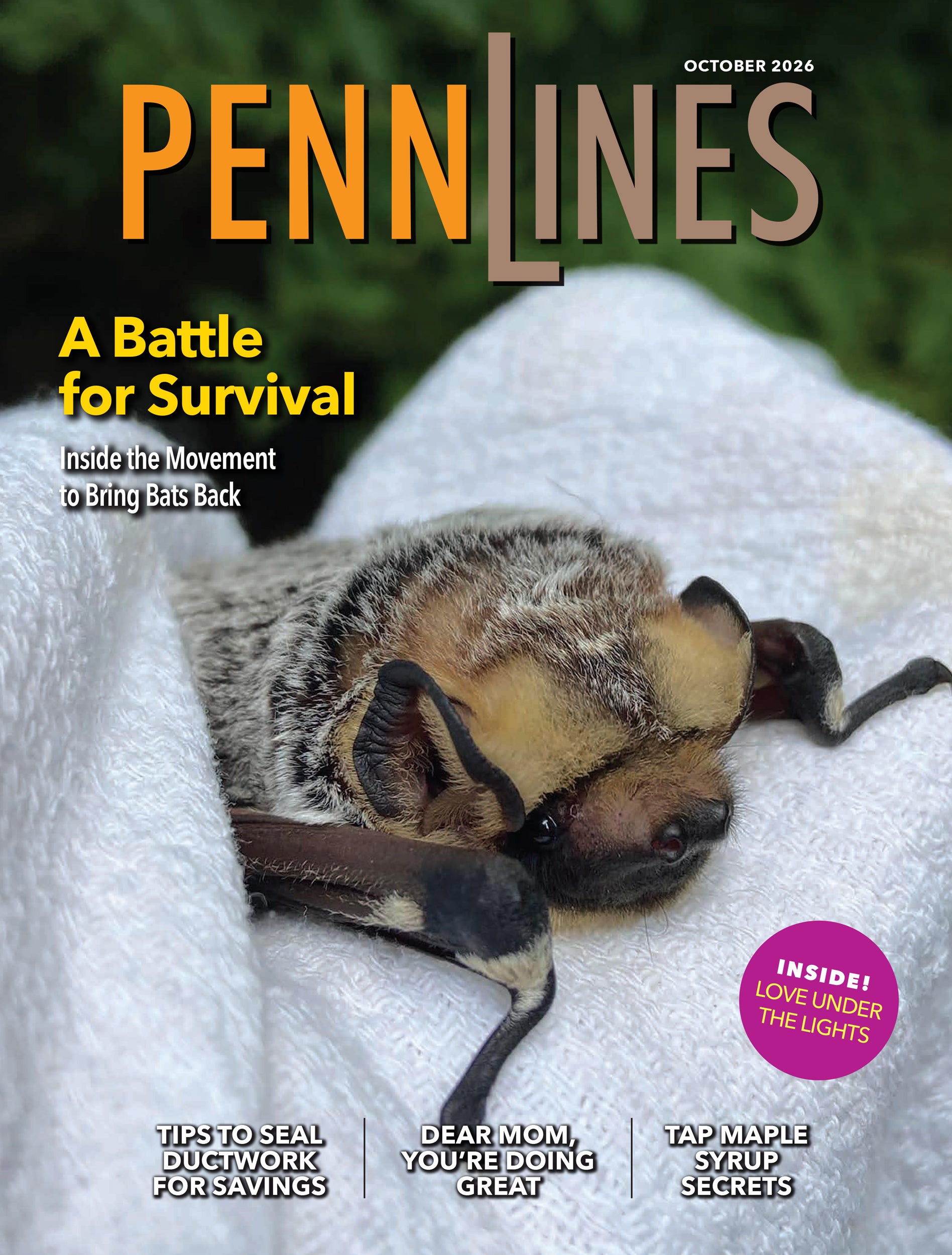
A Battle for Survival
Inside the Movement to Bring Bats Back
Paula Piatt
Penn Lines Contributor
Terry Lobdell was drowning in his carpentry shop.
Left with a mountain of scrap wood, he built some bat houses to soothe his self-admitted “OCD about not wasting things.”
It was not wasted on the bats living nearby.
“I shined the light up at dusk and I saw all these little faces looking down at me from the crevices,” he says of his early shelter attempt. “It was just the deepest experience, and I think it was at that moment I got hooked.”
For the Townville, Pa., resident and Northwestern Rural Electric Cooperative (REC) member, the experience began a decades-long journey of all things chiroptera — a more formal word for bats — that includes houses, presentations, education and innovation. Lobdell even shares his Crawford County property with a colony of about 150 big brown bats.
Today, he’s northwest Pennsylvania’s “go-to” bat guy, one of a small — but dedicated — group throughout the state helping our struggling bat population.
‘The damage was done’
At one time, Pennsylvania was home to an estimated 10 million bats. Nine species are considered “residents.” In the fall, the hoary, eastern red and silver-haired bats wing their way south, while the big brown, little brown, tri-colored, Indiana, small-footed, and northern long-eared bats find a cave or abandoned mine, where they will sleep through the cold months.
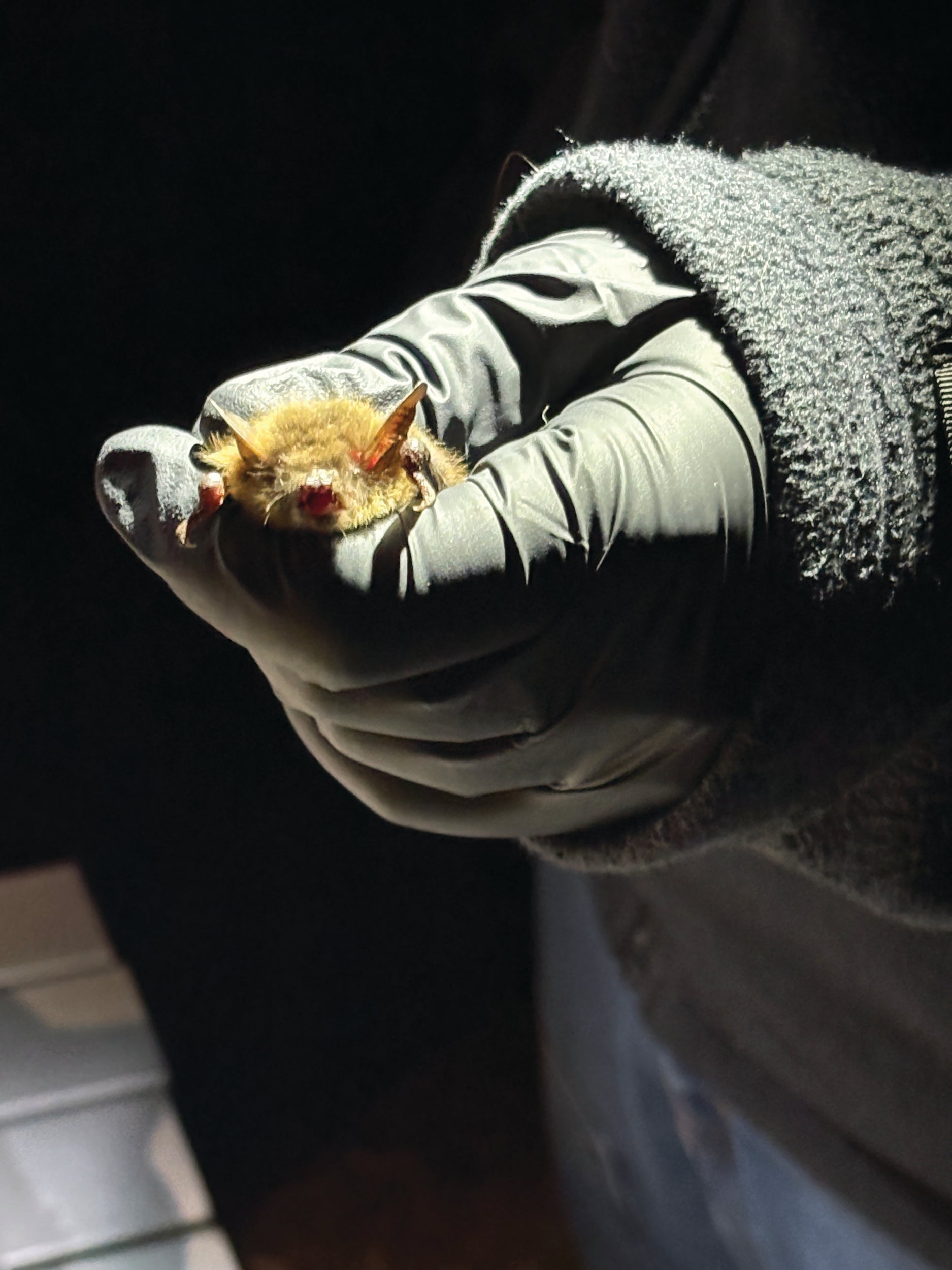
BATTLE TO SURVIVE: Deep in a Blair County abandoned mine, Pennsylvania's bat population is coming back to life. (Photo by Paula Piatt)
All was well until the winter of 2008-2009. Greg Turner, the Pennsylvania Game Commission’s state mammologist in the Wildlife Recovery Division, remembers it well.
“That was the first time we documented it,” he says of white-nose syndrome, a fungus that took only two years to travel from upstate New York to the Keystone State. “And then it just took off. By 2012, the damage was done; it spread across the entire state and killed 99.9% of our cave bats.”
Winter roosting sites, once home to 35,000 bats, were left with 70; a mine with an estimated 50,000 bats was empty.
The fungus thrives in a cold, damp environment and, as true hibernators spending six months sleeping in caves, bats were helpless against its march. As the disease attacked their skin and wing membranes, the bats became dehydrated and emaciated, which disrupted their sleep.
“They weigh about 7 grams,” says Turner, describing little brown bats, one of the hardest hit species. “They have 1 gram of fat to last six months underground and 95% is used coming out of hibernation.”
Periodically, bats leave the cave to groom, get a drink and maybe something to eat. Those infected with white-nose fungus wake up three to four times more often, thirsty from dehydration. Heading out into the winter landscape, they become prey for hungry predators or simply freeze to death. As the winter (and the fungus) wears on, their fat reserves dwindle, leaving them even more vulnerable.
Science, research and storytelling
Those bats that survive white-nose still face innumerable challenges. Encounters with roaming cats, striking windows or becoming trapped in uncovered chimneys and glue traps are just some of the issues that bring bats to Stephanie Stronsick’s Pennsylvania Bat Conservation and Rehabilitation Center in Berks County. With the mission of “protecting Pennsylvania’s vital ecosystems by rescuing, rehabilitating and returning our misunderstood bats to the wild,” it’s the only state organization dedicated solely to the only flying mammal.
“They’re very complicated to rehabilitate, with unique injuries. They also have unique [treatment] protocols to have successful recovery and reintroduction back into the wild,” says Stronsick, a licensed rehabilitator and the center’s founder and executive director.
Of the almost 400 bats the rescue treats each year, the majority are found on the ground, some the victims of white-nose syndrome. “We get a lot of emaciated bats with dehydration,” she says. “They don’t have enough energy to forage or do daily activities.”
But this trio of bat conservationists — Stronsick, Turner and Lobdell — is undeterred. Working together on numerous projects, they’re bringing some light to the end of a long, dark bat cave.
Immersed in science, Stronsick works with Game Commission biologists as well as virologists at Penn State University, pathologists at the University of Pennsylvania’s PennVet Wildlife Futures Program, and microbiologists at Rutgers University, trying to understand these animals.
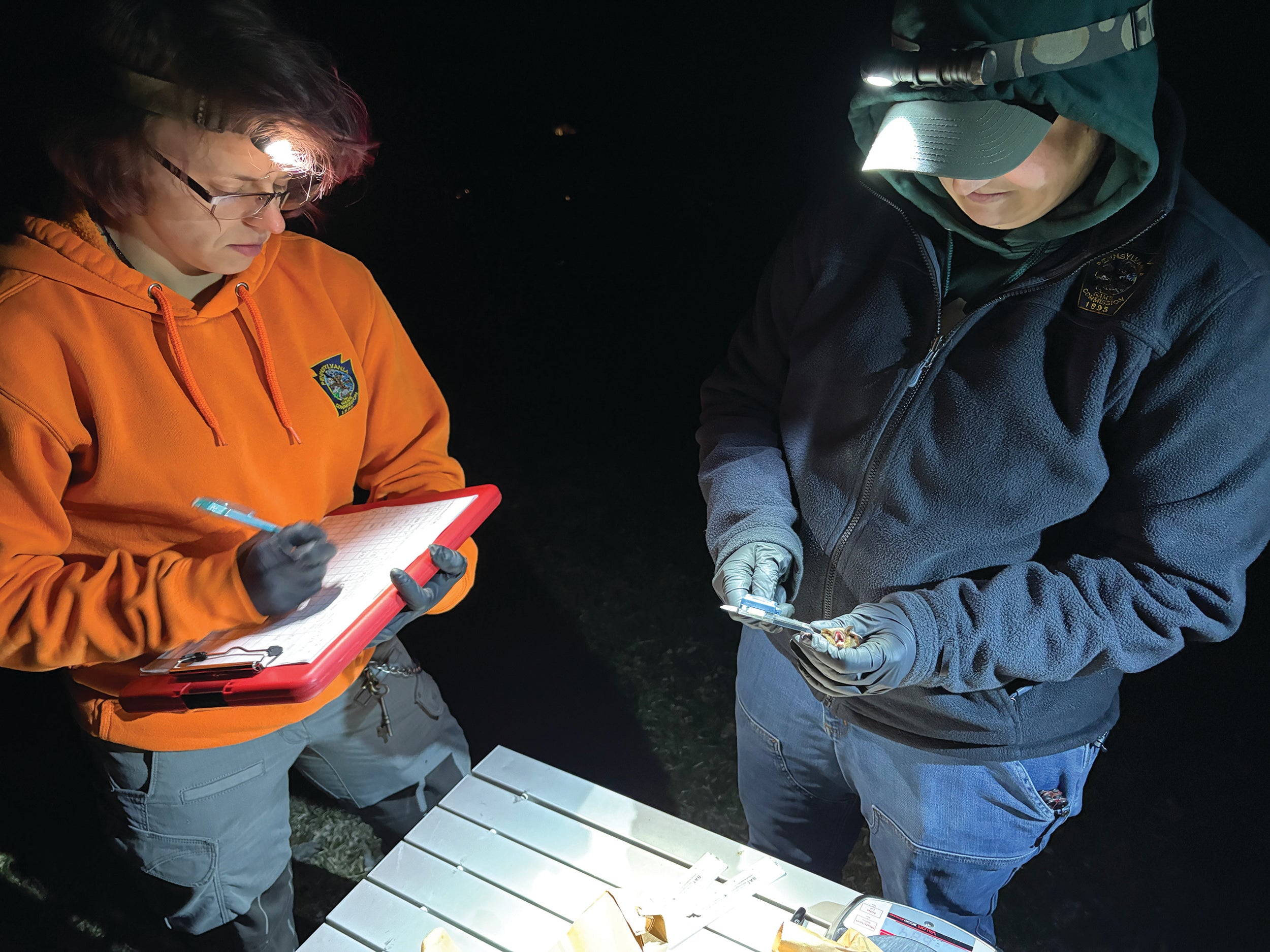
THE REAL BAT CAVE: Greg Turner with the Pennsylvania Game Commission, right, led the effort to create a climate-controlled environment that’s helping protect bats from white-nose syndrome. The fungus spread throughout the state in the early 2000s and nearly wiped out the state’s bat colonies. Today, this Blair County mine has more than 1,200 winter residents and is the third largest hibernation site in the state. It’s also one of the largest tri-colored bat roosts in the northern U.S. (Photo by Paula Piatt)
“We’re really science-based,” she says of the center and her work. “We heavily rely on ethical research, especially dealing with an animal that has a unique immune response. A lot of it has to do with disease surveillance. Wildlife rehabbers are in a unique position when there’s a disease epidemic, whether it impacts humans or not.”
Stronsick has also helped develop treatment protocols for white-nose syndrome, which are used across the Northeast and Canada.
Turner surveys the landscape — monitoring, trapping and tagging a sample of the state’s remaining bats. That’s how he discovered that correct hibernation temperatures can make a big difference when it comes to surviving white-nose syndrome. Finding that the fungus slows down in colder temperatures, he theorized that if he could manipulate the winter roost’s temperature, perhaps he could help the colony. Turner created a climate-controlled mine in Blair County, a region served by Valley REC, and gave the bats what they needed: a winter temperature between 38 and 42 degrees.
Soon, one tri-colored bat became 83, four big brown bats moved in, more than 1,000 little brown bats joined the two original survivors, and this past year, the first federally endangered Indiana bat returned to the mine. Turner is eagerly awaiting a northern long-eared bat, also federally endangered, to join the party. At more than 1,200 winter residents, the abandoned mine has become the third largest hibernation site in the state and one of the largest tri-colored bat roosts in the northern U.S. Six other sites have been modified with varying degrees of success.
Turner now combines temperature regulation with another treatment, developed by a Lock Haven University mycologist, that slows the fungus behind white-nose syndrome. After two years of treatment with a petroleum-based product (found in everything from cosmetics to toothpaste), the pair has reduced the disease in little brown bats by 66% and by 90% in big brown bats.
“The treatment delays exposure,” Turner explains, giving the bats a healthier hibernation.
From northwestern Pennsylvania, Lobdell brings the bats’ story to the people.
“Throughout the year, I probably do 10 or 12 public talks,” he says. “I collaborate with county conservation districts, and I do a lot with the Game Commission.”
His message is pretty simple: Bats are an important part of the ecosystem, and we really should be doing everything we can to help them. “They are very important to our agriculture and forestry economy in Pennsylvania,” Lobdell says, “because of the insects they consume.”
Turner’s calculations put those numbers somewhere between 900,000 and 1 million insects per year, per
bat. Over the course of a summer, each bat averages 5,500 mosquito-sized insects per night.
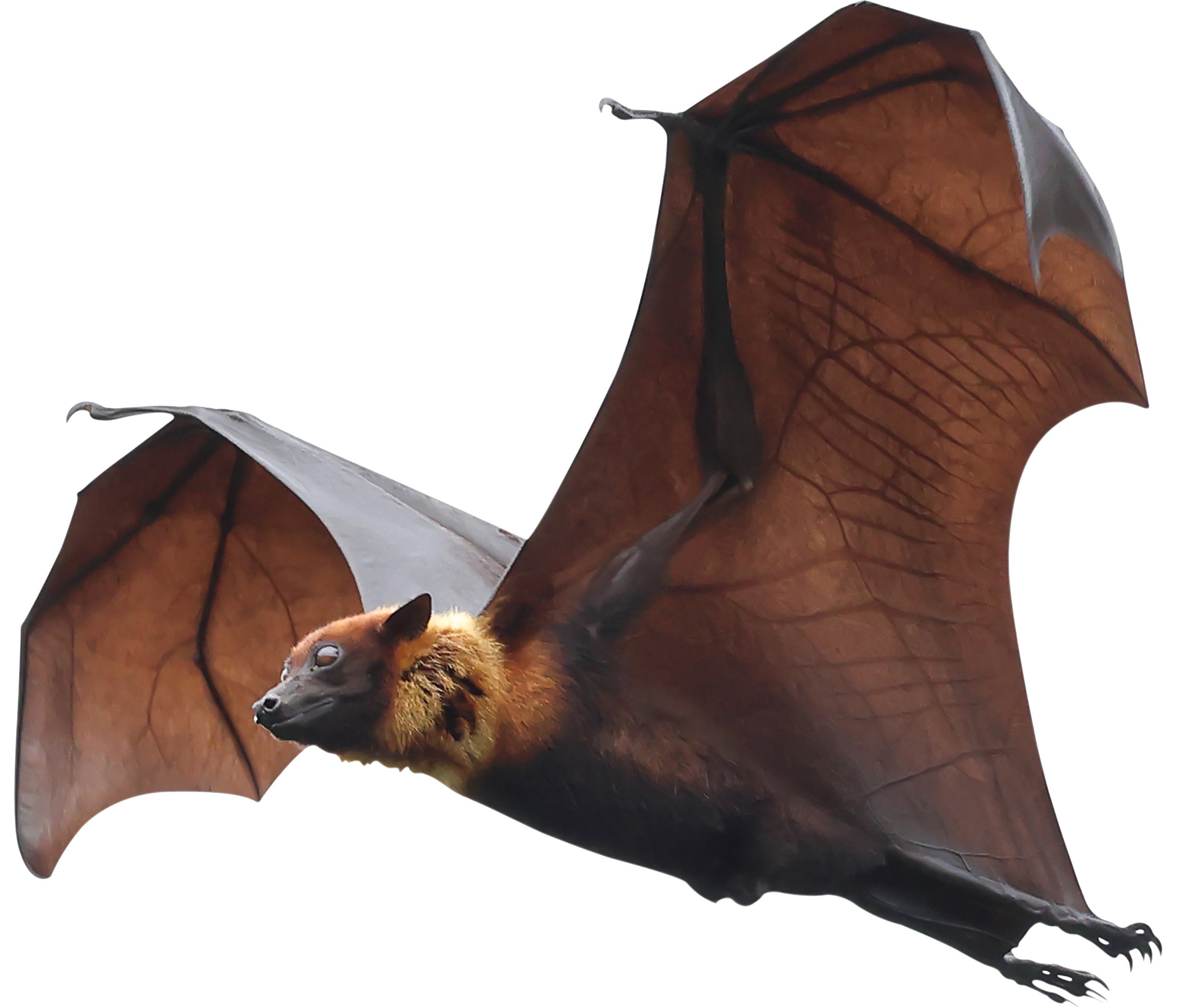
“If you’re a farmer and you have a colony of 300 bats in your barn,” he says, “and they’re eating 300 million insects around your farm, including the ones that are laying larvae that eat the roots of your crops, that’s free pest control.”
A place to call home
A homeowner with a “bat problem,” however, isn’t thinking about the farmer down the road.
“As beneficial as they are, you don’t want them in your house. They want your attic because of the heat; they only come down into your living space by accident,” Lobdell says. “If there’s an existing colony and people are willing, I help them out whenever I can.”
His solution? Offer them a house outside yours. And that’s where Lobdell really shines — his house-building innovations have had a big impact on bat conservation. Stronsick has several of his designs at the Berks County facility.
“She requires specialized bat houses,” Lobdell says, “so I’ll build one specifically for her needs.”
Lobdell’s houses also help rehabilitate bats at the Delaware Bat Rehabilitation and Conservation Center as well as the Lubee Bat Conservancy in Gainesville, Fla. There, he’s created an observation bat house that can be lowered with a winch. A door reveals the bats behind a plexiglass window.
“That’s what I enjoy doing the most,” he says. “If somebody needs a specialized design, I build it and take it to them.”
Closer to home, Lobdell volunteers with the Foundation for Sustainable Forests (FSF) in Spartansburg, Pa., a nonprofit land trust overseeing more than 3,700 acres of working woodlands, including the 106-acre Northwestern REC Community Forest in Cambridge Springs, Crawford County.
Adjacent to the cooperative’s offices, the property was acquired through the generosity of the co-op and a grant by the USDA Forest Service Community Forest Program. It’s managed as a sustainable working woodland, but also hosts recreation and education opportunities.
For a bat project, the foundation knew just who to ask: Terry Lobdell.
“Terry was enthusiastic,” says Bennett Gould, FSF’s conservation and outreach coordinator. “In 2024, he spent a week with a Pennsylvania Outdoor Corps crew, working with them on bat-box projects.”
Effective bat houses tower over the landscape at 12 to
20 feet, so they were going to need a pole. Rural electric
co-ops certainly have one or two, and with Northwestern REC right next door, it was a natural partnership, Gould says.
“They brought over a bucket truck and a utility pole, set the pole for us, and then put Terry up in the bucket to hang [the bat house],” he says. “It was awesome to collaborate with them on that.”
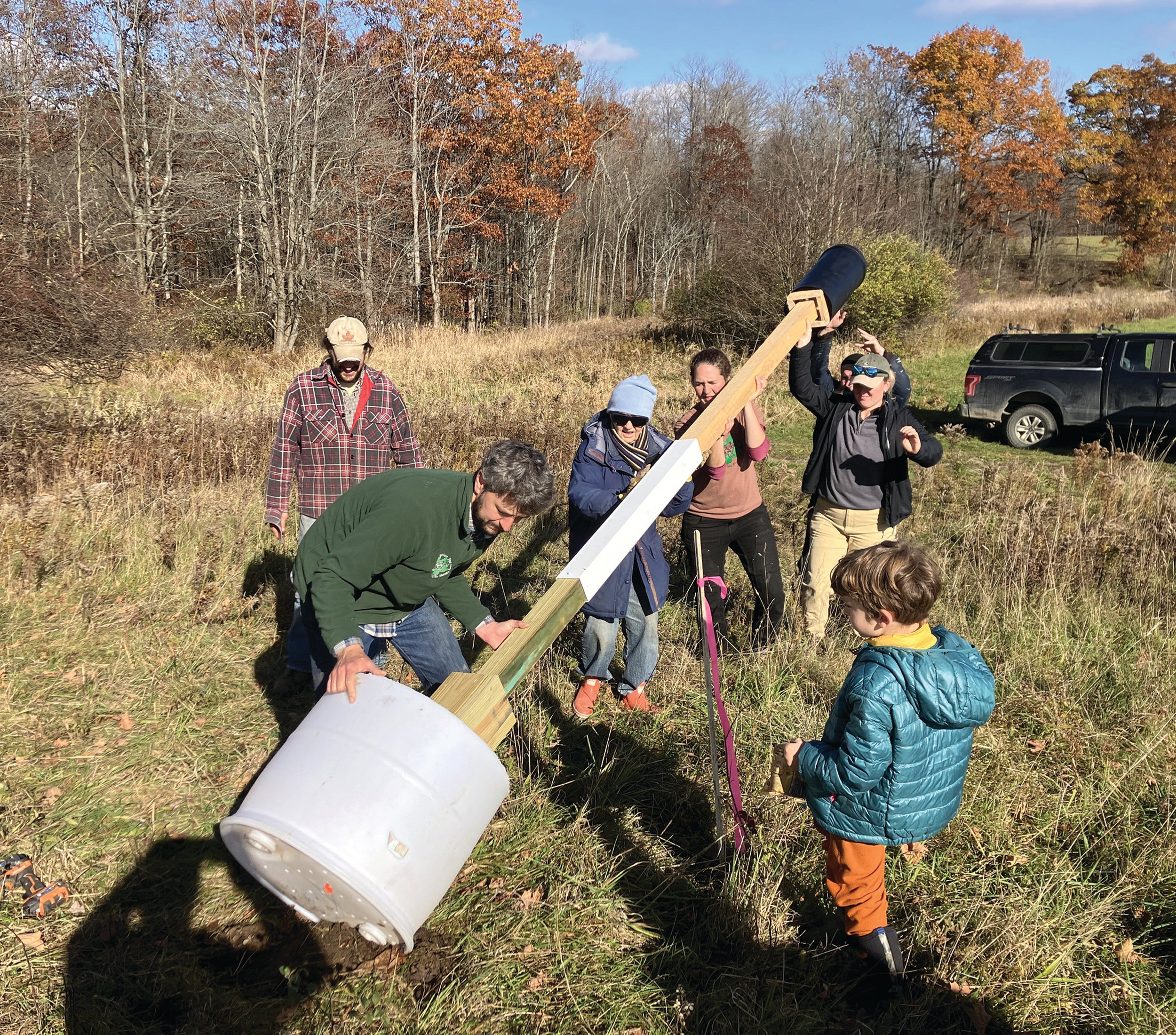
A PLACE TO CALL HOME: Terry Lobdell is a key part of a statewide effort to increase Pennsylvania’s bat population. Lobdell worked with a crew from the Pennsylvania Outdoor Corps in 2024 to build and install bat boxes at the Northwestern Rural Electric Cooperative Community Forest in Crawford County. The effort was coordinated by the Foundation for Sustainable Forests, a nonprofit land trust. The Outdoor Corps, which is overseen by the state Department of Conservation & Natural Resources in partnership with the Student Conservation Association, is a paid job-training and conservation program for young adults. Photo courtesy of the Foundation for Sustainable Forests)
Of course the co-op was happy to help, President & CEO Ryan Meller says.
“Northwestern REC places a strong value on being good stewards of the natural world,” he says. “This reflects our cooperative principle of ‘concern for community,’ and it’s why we were so pleased to partner with the Foundation for Sustainable Forests on this project. Projects like this demonstrate our commitment to supporting local ecosystems while working alongside organizations that share those same values.”
According to Gould, it’s not the first time Northwestern REC has stepped up.
“Working with the co-op has been a real pleasure, from the initial conversations about the community forest, to volunteers, to partnering on events and different things. They’ve been so supportive and receptive,” he says. “It’s fantastic to see how committed they are to the communities they serve and to partnering with us in our work.”
Back at the community forest, Lobdell didn’t stop at just one bat house. In addition to the permanent installation just off Route 86 outside Cambridge Springs, six of his portable “rocket box” designs dot FSF holdings throughout northwestern Pennsylvania.
“In our region, there’s so much tree growth. With a successful bat house, if trees begin to shade the house, the bats will leave, because they require full sun,” Lobdell says, explaining that they need high temperatures to raise their pups in June. “A 50-pound bat house on a 16-foot pole set 36 inches in the ground is a lot of work to relocate. With the portable [rocket box] base, one person can do it in
10 or 15 minutes.”
‘Not all doom and gloom’
Turner, the wildlife biologist, uses the word “recovering,” albeit carefully, when referring to Pennsylvania’s bat population.
“It’s not all doom and gloom for all species,” he says, having seen some improvement in little brown and big brown bat numbers. “If those juveniles are surviving, if the actions we are employing now, and if future actions developed by other researchers can all help improve survival [from white-nose syndrome], then yes, I think recovery can happen.
“The sooner we start, the more it’ll grow and compound,” Turner adds, “so, hopefully, in 10 years’ time, we’ll be at a significantly increased and stable level with all our species.”
For all their efforts, this trio can’t save the bats by themselves; they need help. By reducing pesticide and herbicide use, and planting more native plants, home and landowners can help sustain insect populations and the biodiversity that bats rely on, Stronsick says.
Another valuable step: letting go of the irrational fear surrounding these fascinating animals and giving them a place to live. Every bat house is important, Lobdell says.
“Even if you never get a colony, one or two bats will use a bat house during spring and fall migration just to rest” — something he and the other bat conservationists in the state will likely never do.