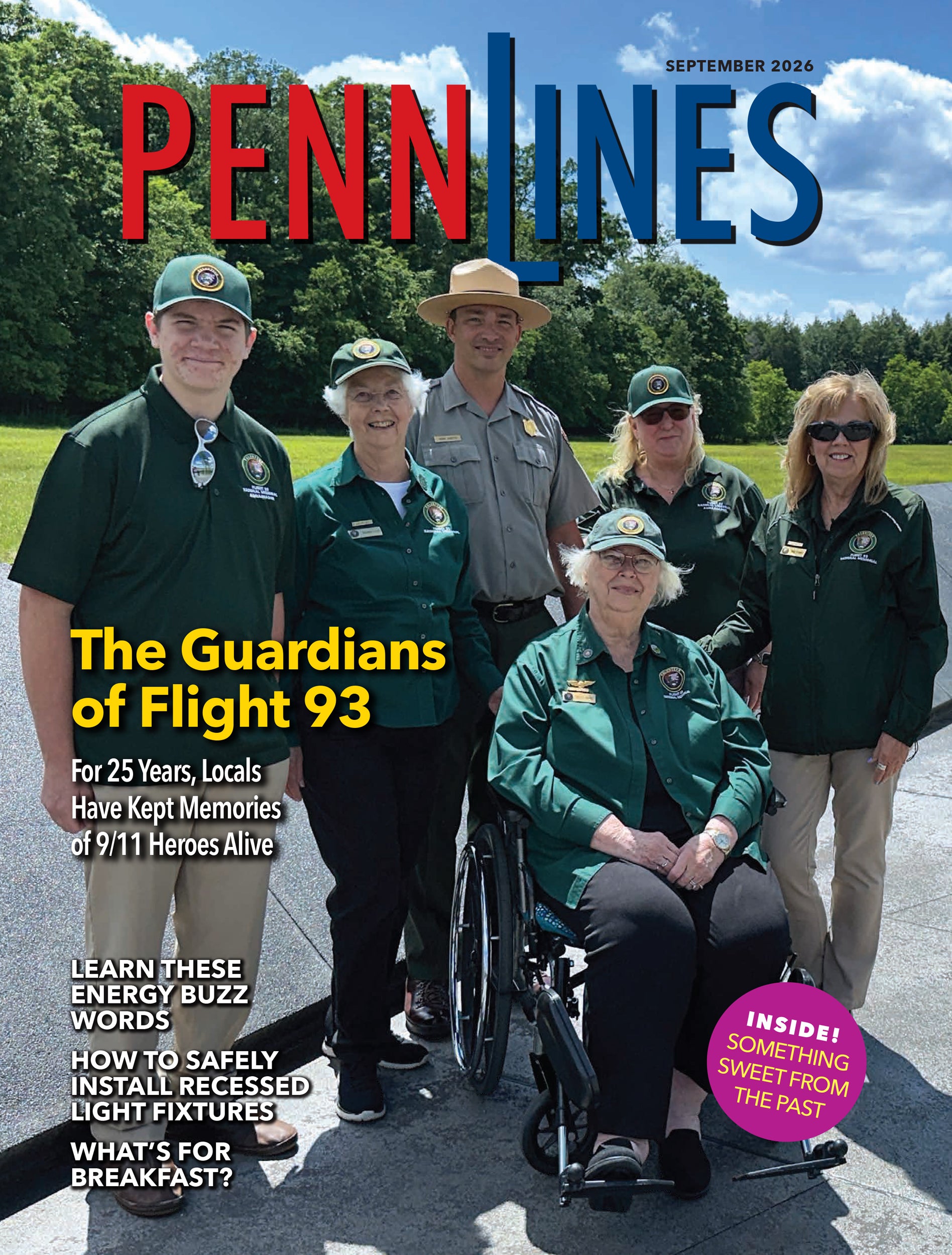
The Guardian Of Flight 93
For 25 Years, Local Have Kept Memories of 9/11 Heroes Alive
By Jeff Fetzer
Penn Lines Contributor
Like millions of Americans, Roxanne Sullivan watched in disbelief as hijacked airliners struck New York City’s World Trade Center and the Pentagon in Washington, D.C.
Later that morning — Sept. 11, 2001 — while she was running errands with a friend in Latrobe, another bulletin came over the radio: An airplane had crashed on the edge of a strip mine in Somerset County, close to the tiny borough of Shanksville.
Roxanne’s mind was racing. Her house, near Shanksville, also bordered a reclaimed strip mine, and her father-in-law lived next door.
She asked a store manager if she could use the telephone to make an emergency call to him.
“I dialed the number,” she says, “and it said it was no longer in service.”
She pauses, recalling her thought at the time: “I’m in trouble.”
Hoping and praying
The pair rushed home and as Roxanne got closer, she was stopped by an emergency responder who asked where she was headed.
“I told him I live on Skyline,” she says. “He said, ‘That’s where the jetliner fell.’ ”
Stopped from going farther, Roxanne turned her car around and took another route to her property, passing emergency vehicles and personnel at every road leading to the strip mine.
“There were cars on both sides of the road and people looking [toward the crash site], and then the smell hit me — the burnt diesel smell,” she says.
Roxanne parked and began running through a field toward her house, praying it and her father-in-law’s home were still standing.
They were — but they weren’t untouched.
Pictures that had adorned the walls were scattered on the floor, jarred from their hangers by the impact of a Boeing 757 — United Airlines Flight 93 — which had plunged into the ground less than a mile away.
“I had no electricity, no phone,” the Somerset Rural Electric Cooperative (REC) member says, noting the plane had taken out the lines as it crashed. “I went back to the bedroom and laid on the bed and cried.”
After regaining her composure, Roxanne ventured to her father-in-law’s home. She found him unharmed, sitting in his recliner. He told Roxanne he was watching the “Today Show” when he heard the plane hurtling toward Earth.
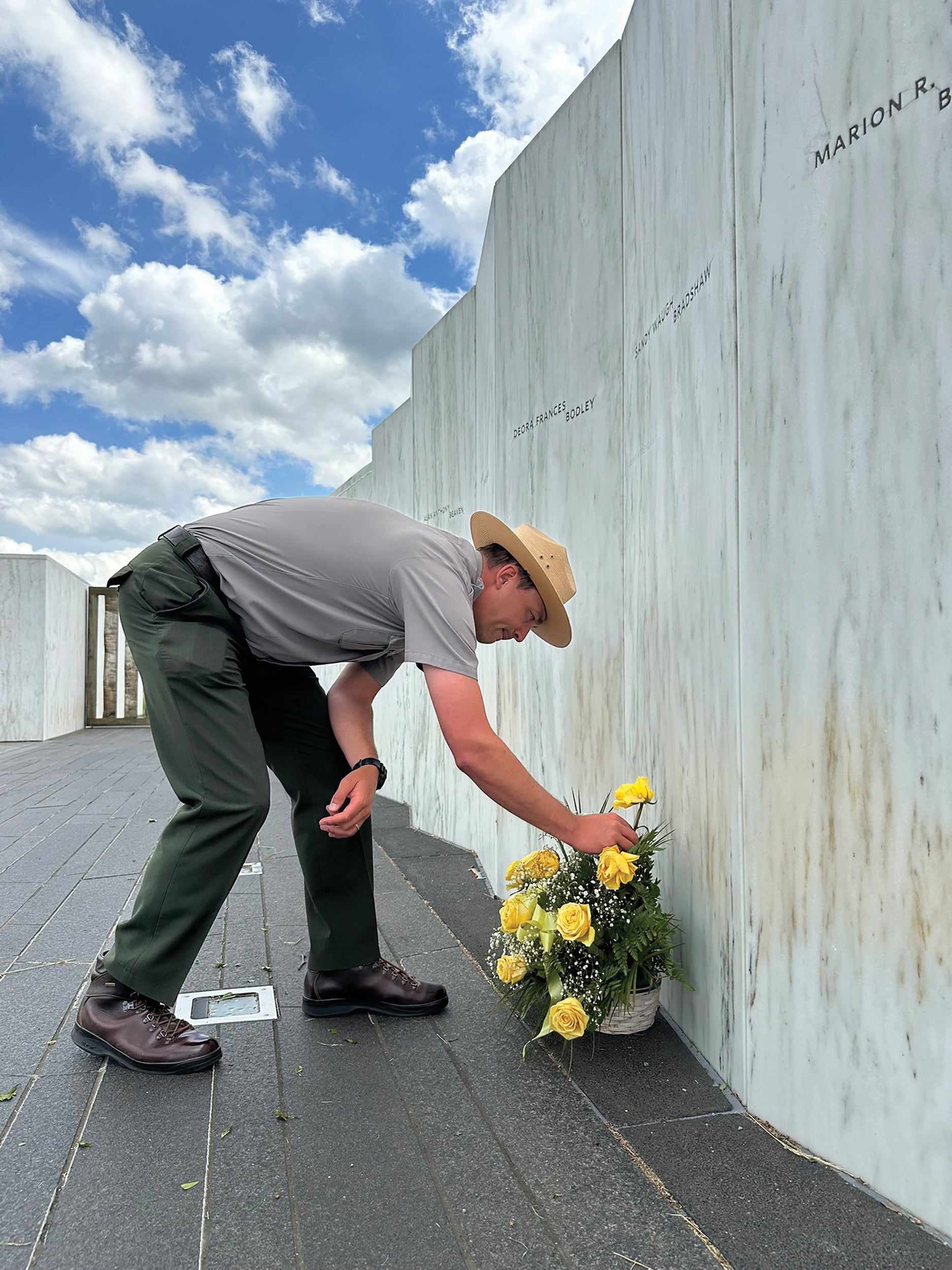
NEVER FORGOTTEN: Today, Adam Shaffer is chief of interpretation and education for the Flight 93 National Memorial in Somerset County. In 2001, however, the Shanksville native was among the original ambassadors to greet visitors at the crash site and share the stories of the flight's heroes. (Photos by Jeff Fetzer)
“He said it sounded like a freight train,” she recalls. “It got louder and louder and screechier. He got up from his recliner to look out the kitchen window. When it hit, it stepped him back.”
‘I will take care of you’
Seeing a massive cloud of smoke from the explosion, her father-in-law picked up the phone to report the crash, but the line was already dead. He went back to his recliner; there was nothing else he could do.
“I cried for three days straight,” Roxanne says. “How do you handle a jetliner falling in your backyard? You don’t.”
Thirteen days after terrorists hijacked Flight 93 and crashed the plane into the Stonycreek Township strip mine, officials told Roxanne she could visit the site. Their ground investigation was done.
The next morning, in the pouring rain, she paid her respects. “I said a prayer for their souls and vowed, ‘I will take care of you until the day I die.’ ”
Twenty-five years later, she has kept that promise, greeting visitors at the Flight 93 National Memorial near Shanksville as one of its longest-serving volunteer ambassadors.
But Roxanne Sullivan wasn’t the only community member who made a personal pledge to “never forget” the crew and passengers of Flight 93.
Within months of the crash, she and nearly 40 other Somerset County residents formed a volunteer team. Their mission was — and still is — to provide accurate information to the parade of visitors who travel to the crash site to remember the heroes of Flight 93.
Where it all began
United Airlines Flight 93 was one of four commercial airliners hijacked by al-Qaida terrorists on that life-changing September day. After learning about the attacks on New York and the Pentagon earlier that morning, the passengers and crew fought to retake the aircraft as it flew toward Washington, D.C. As the struggle ensued, the plane took a nose-dive near Shanksville.
The seven crew members and 33 passengers aboard perished, but their brave actions prevented the four hijackers from reaching their intended target, the U.S. Capitol. Today, their heroism is commemorated at the Flight 93 National Memorial.
Operated by the National Park Service, the site draws more than 350,000 visitors a year from around the globe. While there, visitors can hike the half-mile Trail of Remembrance to access the site where the first memorial — a temporary one — stood. This is where the story of the Flight 93 ambassadors began.
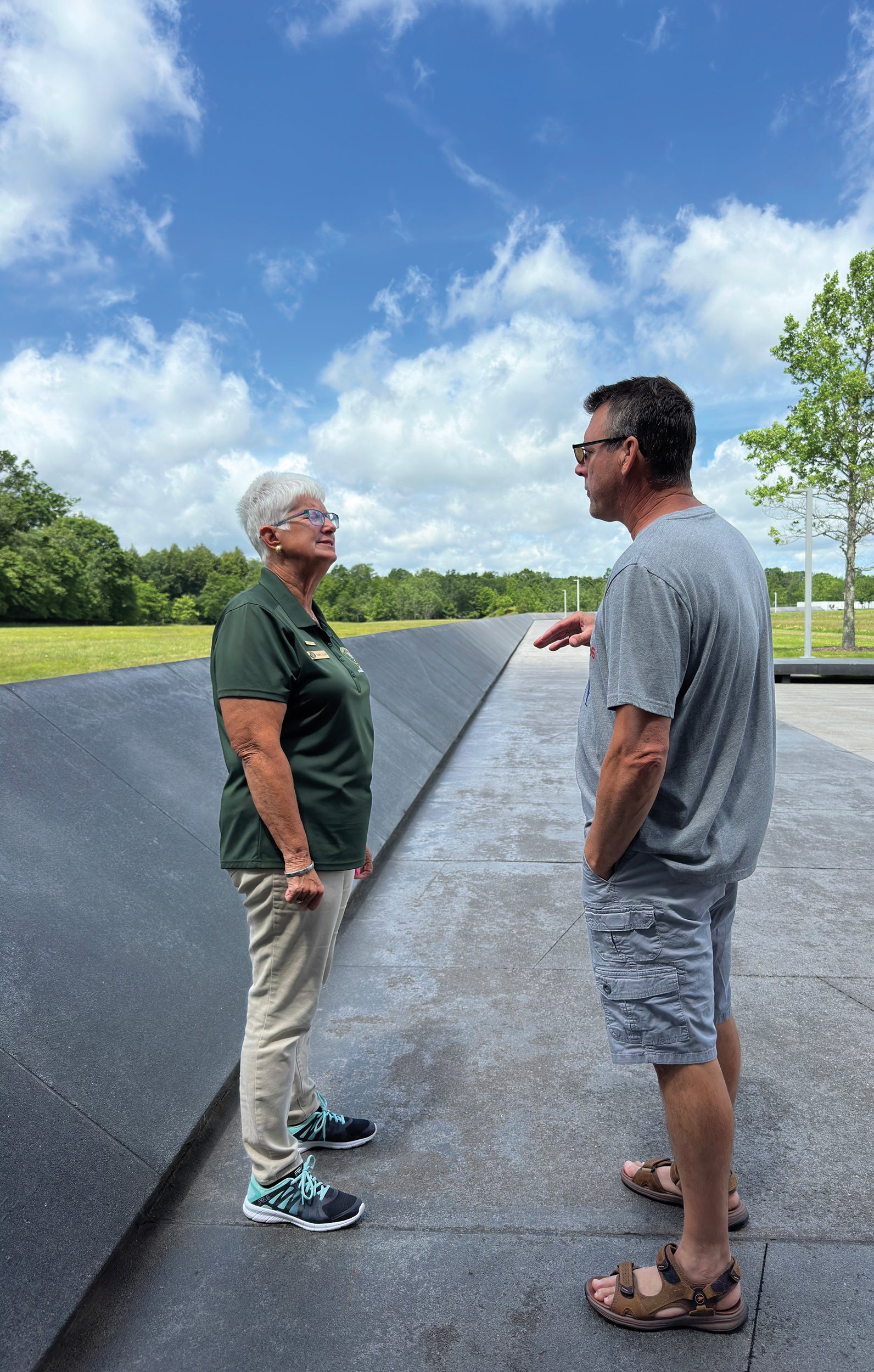
A PROMISE KEPT: Ambassador Roxanne Sullivan, who lives less than a mile from the Flight 93 crash site in Somerset County, made a vow 25 years ago to keep the victims' memories alive. She is one of two original ambassadors who continue to volunteer today.
The temporary memorial, which opened Oct. 31, 2001, was little more than a pull-off spot on a dirt road. The gravel parking area overlooked the wide expanse of reclaimed mining land. A pair of abandoned drag lines, a handful of outbuildings, piles of scrap metal and several ponds were visible from the site, but little else was. There were no amenities — no shelter, no restrooms, no electricity or lighting, no informational displays, and no signs pointing to the impact site, which was 500 yards away and barely noticeable. There was, however, a 40-foot-long chain-link fence that held a 4-by-8-foot piece of plywood, painted white, where visitors could write messages and leave tributes to the Flight 93 victims.
“When the temporary memorial opened, the floodgates of emotion opened,” recalls Somerset REC member Donna Glessner, who helped spearhead the ambassador program. “There were people from all over the country, all over the world, the media, coming to Shanksville.”
About 3 miles from the crash site, Shanksville is a borough of about 200 residents in a scenic, rural area of the Laurel Highlands. The village is home to a handful of businesses: a corner market, an automotive repair shop, and a hardware store owned by Donna’s husband, Karl. There are no gas stations, no restaurants, no grocery stores, no lodging facilities.
“It was surreal to think that something of international importance happened in a place like Shanksville,” Donna says. “But it made us all realize that there is no place so remote that it can’t be affected by terrorism.”
Donna, whose home is also near the crash site, jumped into action following the disaster, packaging and delivering food and drinks to emergency responders. She didn’t return to the site again until a few months later when she decided to visit the temporary memorial for the first time.
“I hear people talking, and they are very confused,” Donna recalls. “They wondered where the plane crashed.”
She watched as several people took videos and photographs of the metal scrap yard that was visible from the memorial site, mistakenly thinking it was wreckage from the plane.
“I went home feeling sick,” she says. “I didn’t want people taking the incorrect story back home with them.”
Tears and tissues
A Shanksville native with a passion for local history and volunteerism, Donna decided to see if she could recruit members of the community to staff the temporary memorial site. That group has served as greeters at the Flight 93 memorial site ever since.
“We decided to call ourselves ambassadors,” Donna explains, “because we wanted to, as a community, put our best foot forward and welcome visitors to this place.”
By February 2002, about 40 volunteers had committed to staffing the temporary memorial site daily, year-round. Initially, the ambassadors worked hour-and-a half to two-hour shifts, sometimes in pairs, sometimes alone, with no shelter from the weather and scant details about the Flight 93 crash.
“We didn’t know a lot about the event at first,” Donna says. “That unfolded over years. But we could show people where the plane crashed. We could tell them where they could find a gas station.”
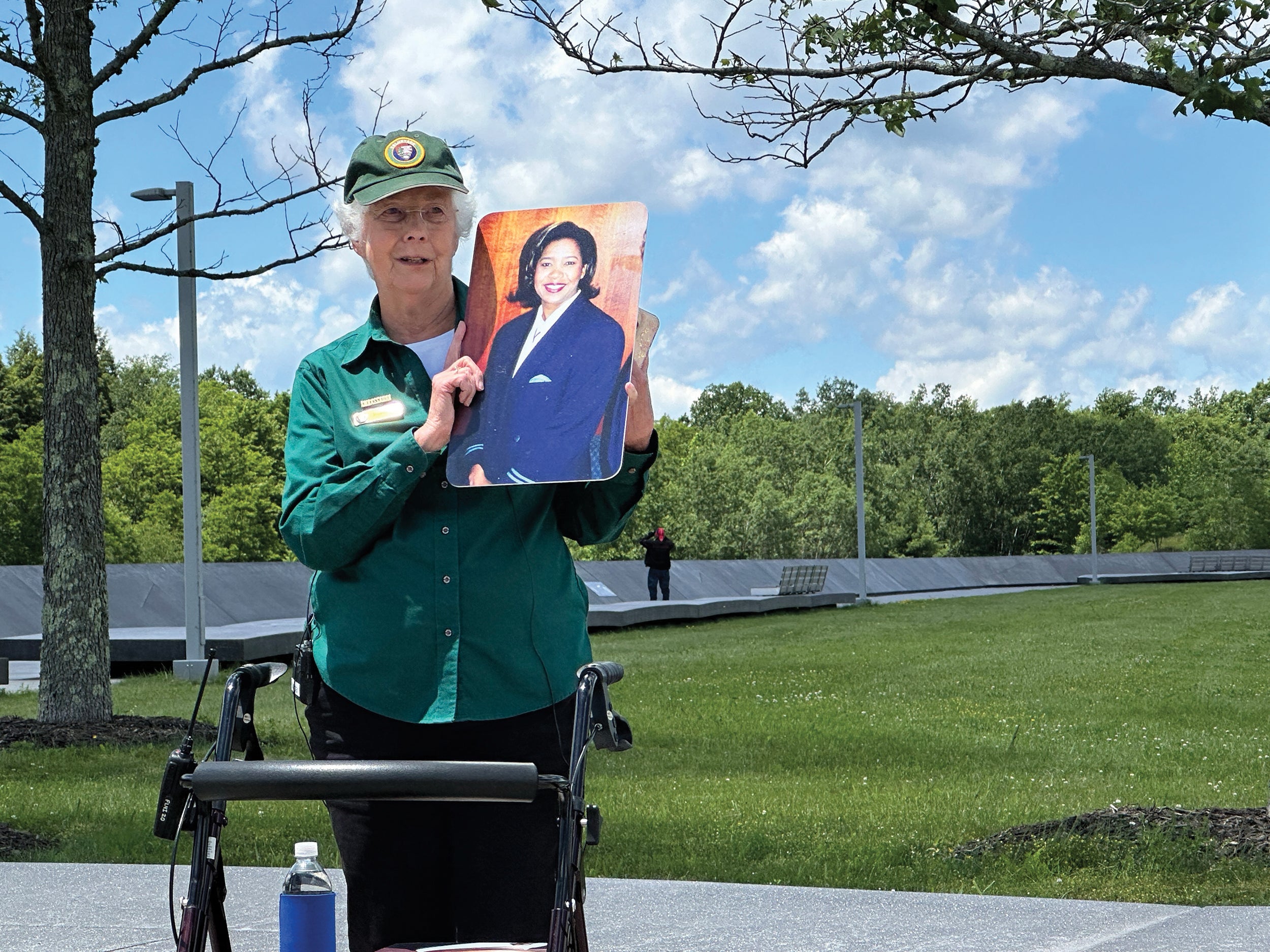
ONE OF THE STORY-BEARERS: Every Wednesday afternoon during the summer, Flight 93 Ambassador Roseanne Croyle gives a half-hour presentation about the flight’s heroes. Here, she holds a photo of Flight Attendant CeeCee Ross Lyles, who called her husband before boarding the flight, telling him she anticipated an “easy day.”
Mostly, though, they offered visitors a sympathetic ear.
“People wanted to tell us what they thought about 9/11 and where they were,” she says. “We just listened a lot, and we handed out a lot of tissues.”
Despite the heightened emotions, or maybe because of them, Roxanne Sullivan recalls those early shifts with fondness. “In the beginning, everyone was so united after 9/11,” she says. “So many people were coming here, and they hadn’t forgotten. It helped heal me.”
Chuck Wagner, another original ambassador and Somerset REC member, remembers the somber mood at the temporary memorial. “It was quiet,” he says. “It was like you stepped on holy ground.”
Following the crash, Chuck volunteered to operate a skid steer loader to help with the recovery. That, accompanied by a heightened sense of patriotism, fueled his desire to do more.
For the next 22 years, he and his wife, Jayne, would work as ambassadors every Sunday afternoon. He stepped away from those duties three years ago for health reasons but hopes to return.
“It gives you a sense of fulfillment,” Chuck says. “We were helping to fulfill the human need there at the site.”
‘We vowed never to forget’
As more information about the brave actions of the Flight 93 passengers and crew members became known, the ambassadors began telling those stories, which continue to be shared with visitors today. Every Wednesday afternoon during the summer, ambassador Roseanne Croyle gives a half-hour presentation at the Memorial Plaza about the flight’s heroes.
On a recent bluebird day in June in front of dozens of visitors, Roseanne held up a photo of CeeCee Ross Lyles, 33, a mom and former police officer who began working as a United Airlines flight attendant in January 2001.
“When CeeCee was out, away from home, working, she would call her husband a number of times during the day just to check in and see how things were going,” Roseanne told the group. “On that morning of Sept. 11, she had already talked to him twice before she ever even got to the airport.
“When she got there and got her assignment, she called him again and said, ‘I’ll be on Flight 93, but it’s a light load. I’ve got an easy day.’ ”
Roseanne paused for a moment and then held up a photo of passenger Thomas Burnett. A 38-year-old married father of three, he was the chief operating officer of a company that makes heart pumps for those awaiting transplants.
“He had booked a later flight,” she said, “but when he got to the airport early that morning, they said, ‘We have lots of extra room on this earlier flight. If you want, you can board Flight 93, and you’ll get home to your family an hour earlier.’ ”
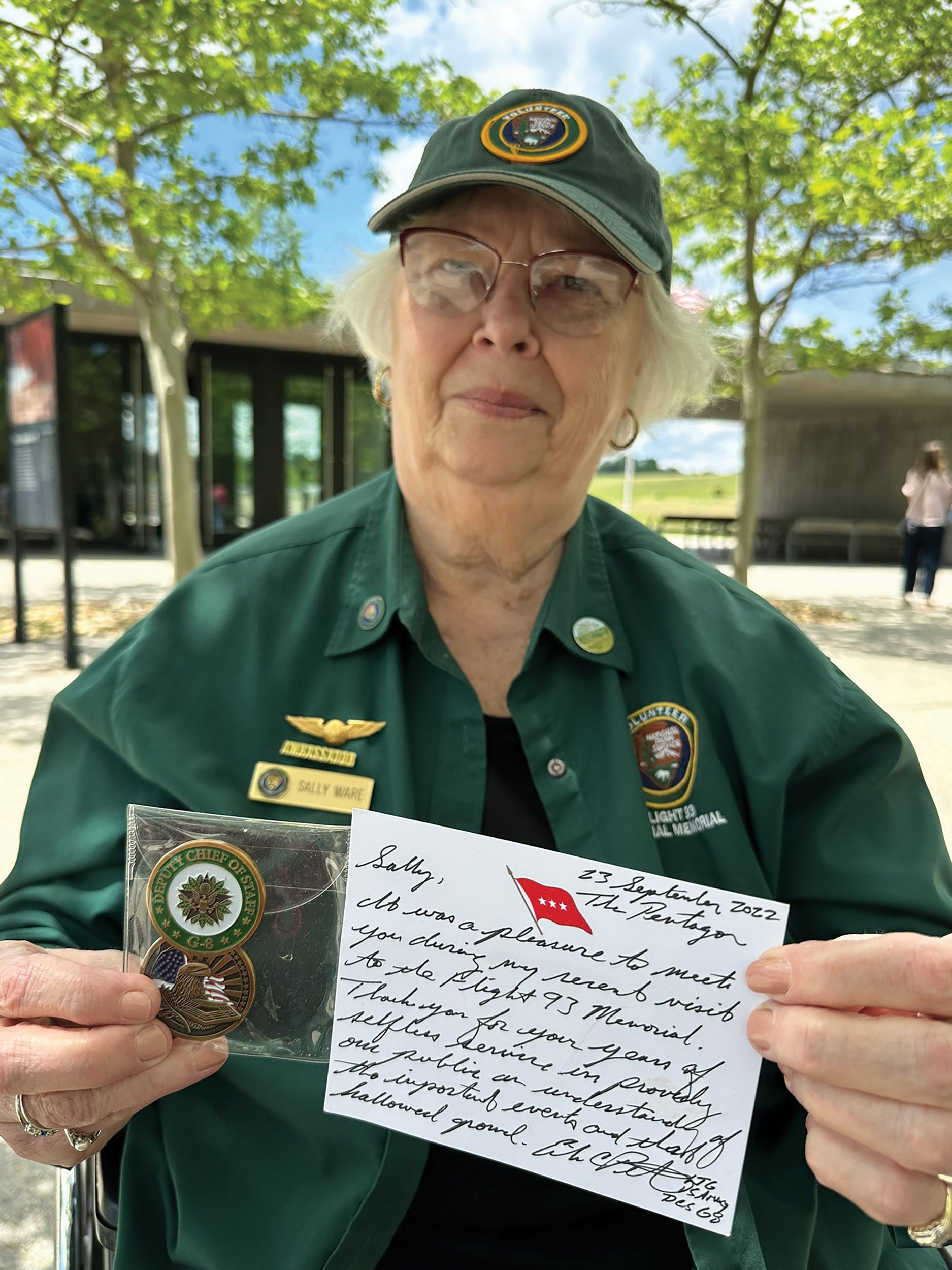
ALWAYS AN AMBASSADOR: One of two remaining original Flight 93 ambassadors, Sally Ware helps educate new generations of visitors at the memorial site in Somerset County. She’s spoken to people from near and far, and from all walks of life. Here, she holds a note and a gift from a five-star general, a visitor to the site who thanked her for her “selfless service.”
According to the National Park Service website, Burnett made four calls to his wife while onboard Flight 93. Those calls provided important details to the passengers and crew about the other hijackings that had taken place that morning. They also revealed that the people onboard were planning to take back the plane from the hijackers, which some consider the first battle in the War on Terror.
“The 40 heroes only had about 30 minutes,” Roseanne says. “In that time, they gathered information, they took a vote, they formulated a plan, they called their loved ones, and then they attacked the cockpit in an attempt to take control of the plane. And because they took action, they no doubt saved an untold number of lives in Washington, D.C.”
Roseanne, 82, joined the ambassador team in 2010 after retiring as a home health nurse. Fifteen years later, she says she plans to continue serving as an ambassador as long as she is able. “It’s the most rewarding thing I have done in my life,” she says. “It’s such an honor to be allowed to work here.
When you think of these 40 people and what they did, this is such a minor little thing that I do — not to repay them, but to honor them. We vowed never to forget.”
Forever connected
Like Roseanne, Somerset REC member Connie Stevanus became an ambassador after retiring. In fact, she says, her late husband, Sam, encouraged her to retire early so she could join him as a volunteer. That was in 2006.
Connie, who has lived at Indian Lake — about three miles from the crash site — for 38 years, says that on 9/11, she came home from work to find her husband holding a bag and picking up pieces of charred debris from the crash that had settled in their yard.
That forever connected the couple to the tragedy.
Connie and Sam visited the crash site less than a week after the on-site investigation ended. They noticed the impact site had been backfilled with soil, but little else pointed to the fact that an international tragedy had happened there.
“There was nobody here,” she recalls. “There was no flag, no people talking. All I remember is the sound of the birds and the rustling of the high grass. It will be etched in my mind forever.”
When Connie begins her weekly shift at the Memorial Plaza, she’s often reminded of that day.
“When I start here at 9 o’clock, there is usually nobody here,” she says. “I just stand here and hear the birds and the wind blowing through the trees, and I just think, ‘What a beautiful place to have been laid to rest.’ ”
Of the thousands of interactions she has had while greeting visitors over the past two decades, Stevanus says one in particular stands out. A man approached her, saying he was a college roommate and lifelong friend of passenger Joseph DeLuca, who was on his way to Napa Valley with his girlfriend, Linda Gronlund.
“He told me that Joe was the best man in his wedding, and that Joe had told him he was going to propose to Linda on this trip and had the diamond ring with him,” Connie says. “I don’t know if the ring was ever recovered.”
The story-bearers
Adam Shaffer, chief of interpretation and education for the Flight 93 National Memorial, says the buildings, exhibits and monuments at the site tell the story of
Flight 93; the ambassadors, however, give that story a human voice.
And he would know. The Shanksville native has been involved with the Flight 93 memorial from Day 1. In addition to being one of the original ambassadors, he interned at the National Memorial while in college and was a park ranger and volunteer coordinator there for 14 years. Today, he oversees visitor services at the site.
“The volunteer ambassadors are absolutely integral to the visitor experience here,” Adam says, noting many share their personal memories of 9/11 and the Flight 93 crash, the impacts on the community, and how the memorial site has evolved from a roadside pull-off to a 2,200-acre national park.
“The ambassadors have been witness to the transformation of the site from the very beginning,” he adds. “They are intertwined with the site’s history forever. They truly have been the story-bearers for 25 years.”
Today, only two of the original volunteers remain on the schedule: Roxanne Sullivan and Sally Ware.
Like many of her fellow volunteers, Sally says the events of the day hit close to home. Her daughter, a flight attendant for American Airlines, was scheduled to fly out of Washington, D.C., at 1:30 p.m. on 9/11.
“Thank God she was safe,” Sally says. “She lost her job for a year, but she’s still working as a flight attendant today.”
Sally says she never imagined that the commitment she made in 2002 would still be part of her life nearly a quarter-century later.
“I was 57 then. Now, I’m 82, and I can’t walk. It’s still a wonderful experience. I love talking to people. I love meeting people.”
Every Wednesday afternoon, she rolls her wheelchair into position so she can greet another generation of visitors at the Memorial Plaza.
“It’s become part of my life,” Sally says. “When you’re here, you forget your problems. You forget your aches and pains when you think of those 40 people and what they went through.”
She smiles: “We’ve got to keep their memory alive. Everybody needs to know what happened here.”